What’s that smell? Meet Dracunculus vulgaris
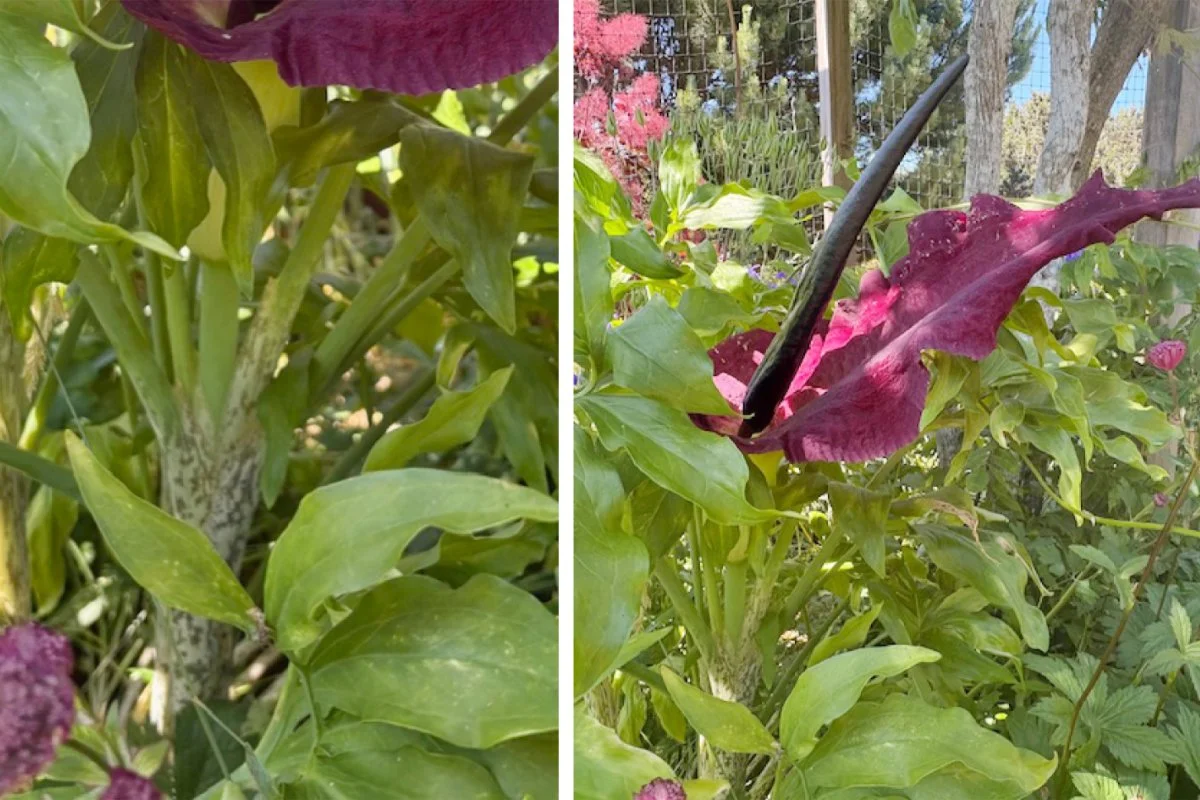
Left, closeup of the main stalk of Dracunculus vulgaris shows the typical snakeskin pattern that adds to the plant’s exotic appearance. Right, the ‘flower’ of Dracunculus vulgaris is actually a large purple pseudo leaf containing an equally long and darker pseudo stalk.
Oh, to be dark, striking and putrid: What more could one ask of a flowering plant that’s been added to a garden specifically to inject a touch of ‘something different’? Dracunculus vulgaris, a.k.a. dragon lily, dragon arum, voodoo lily, snake lily, vampire lily, stink lily, offers all of this. With a huge maroon flower, tropical-looking foliage, and a disgusting stench, this summer beauty can, and often does, stop passersby in their tracks.
Stench aside, I have been fascinated by this plant ever since I got one at a garden club plant sale many years ago. I’ve always referred to it as a voodoo lily, although it seems that dragon lily is the more common moniker. (The word dracunculus, in fact, means ‘little dragon’ and was ascribed to the plant because the leaves were thought to resemble a dragon’s feet).
The dragon lily is a perennial deciduous tuber. Sprouting in early spring, it sends up a beautifully patterned stalk that supports large, deeply lobed leaves. In late June/early July, a deep maroon pseudo leaf, or spathe, unfurls, revealing a shiny black-purple pseudo stalk, or spadix, which can easily reach one foot in length. It’s the spadix that contains the plant’s actual flowers, which are inconspicuous and unisexual.
Here's where things get more interesting. To produce its seeds, the dragon lily requires carrion-eating pollinators, usually flies. To attract the flies at just the right time, which is precisely when flowering is at its peak, it emits an odour akin to rotting meat. The smell lasts for two or three days, during which time visiting pollinators are ‘detained’ by the sticky inner surface of the spathe. (Interestingly, the plant can maintain its own temperature at around 18C, which probably helps to keep the visitors comfortable during their stay.)
Once this brief pollination period is over, the flower starts to dry, the odour subsides and the pollinators are ‘released.’ Everyone can then go back to enjoying the plant up close.
As plants go, this one is super easy to grow and manage. Left alone, it spreads slowly via tuber offsets. It can be propagated by seed (produced in berry form following pollination) or by tuber division. Because it’s deer- and rabbit-resistant, it can be planted just about anywhere in full or part sun, provided the site is well-draining and receives water during dry spells. Native to Crete, the Balkans, Greece and temperate/cooler parts of the Mediterranean, the dragon lily, while it may look tropical, is hardy and resilient in our climate. It’s also suitable for containers.
It's fun having the ‘exotic’ Dracunculus vulgaris in the garden, if only because it never fails to elicit oohs and aahs and lots of questions. That initial tuber has turned into a patch approximately 3’x4’, with individual plants almost three feet tall. Under better growing conditions, they might be a foot taller and produce even larger flowers. Still, they never fail to impress.
To those considering the addition of a dragon lily to their garden, I say, “Go for it!” However, I have two cautions. First, plant it away from doors, windows and seating areas. The noxious smell, however short-lived, is singularly unpleasant and attracts lots of flies. Second, be aware that this plant is toxic to people and pets. Even its sap can irritate the skin. Just remember to wear gloves when cutting the flowers, dividing the tubers, and otherwise working with it.