Let’s Talk Plants with Loretta: It’s a holiday cactus – but what kind?
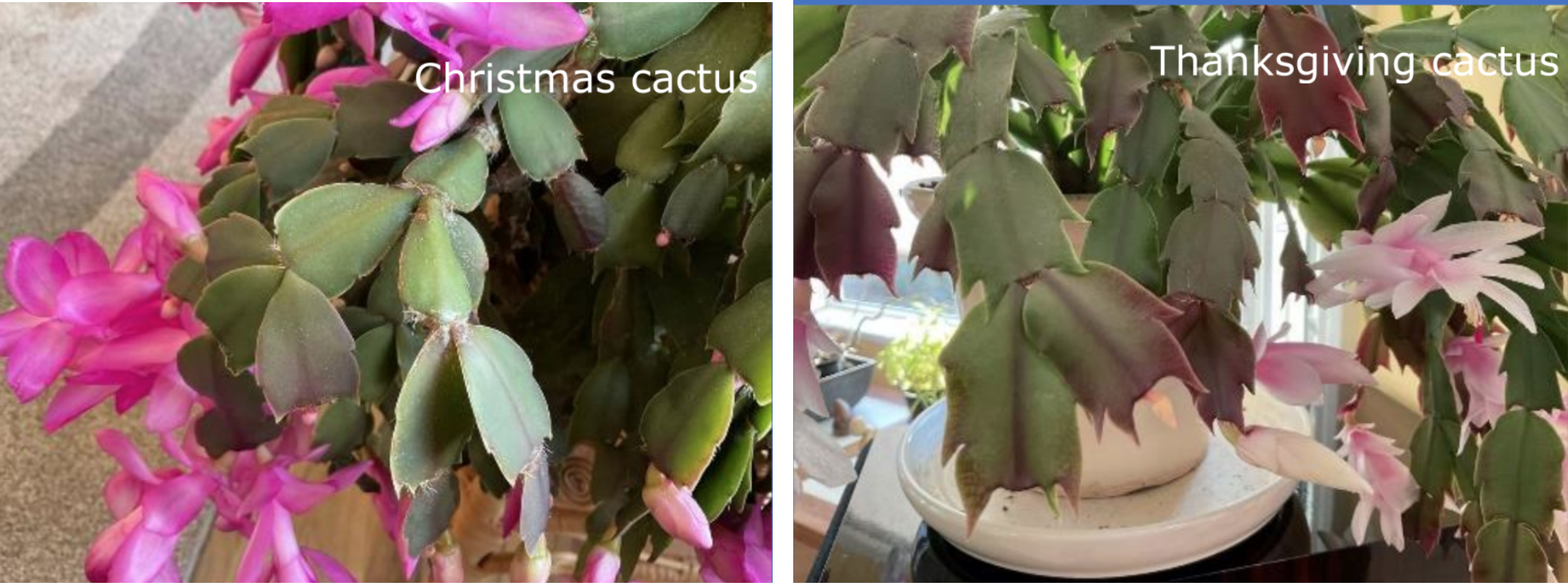
Christmas cactus, left, and Thanksgiving cactus, right.
I decided to write about holiday cacti when someone recently asked if I knew why her Christmas cactus was blooming so far ahead of Christmas. I glibly offered that she likely had a Thanksgiving cactus. Not to be confused, of course, with the Easter cactus.
In any case, this prompted me to take a closer look at my own holiday cacti to see precisely what I have.
First, some general information. All three species are part of the Schlumbergera genus of cacti native to the Brazilian rainforests where, like orchids, they grow on trees or rocks.
(Who knew??) Their leaves are nothing but segmented, flatish stems with a trailing habit, and their flowers grow at the stem notches or tips. The species’ differences are subtle, so how do you know for sure which one(s) you have?
An obvious consideration is the bloom time. While the common name is intended as an indicator, the Thanksgiving cactus (Schlumbergera truncata) and the Christmas cactus (Schlumbergera x buckleyi, also called Schlumbergers bridgesii), far and away the most common of the three, are often confused because their bloom times are so close together and may even overlap. They are also often mislabeled as each other or sold simply as “holiday cactus” in the fall.
Thanksgiving cacti generally bloom in mid/late fall and Christmas cacti in late fall/early winter. These plants, however, are daylight sensitive and flowering is triggered by their growing conditions, namely, hours of darkness and temperature. These two species may also rebloom a few months later. Easter cacti (Rhipsalidopsis gaertneri, often called Schlumbergera gaertneri), on the other hand, bloom in early spring and only once a year.
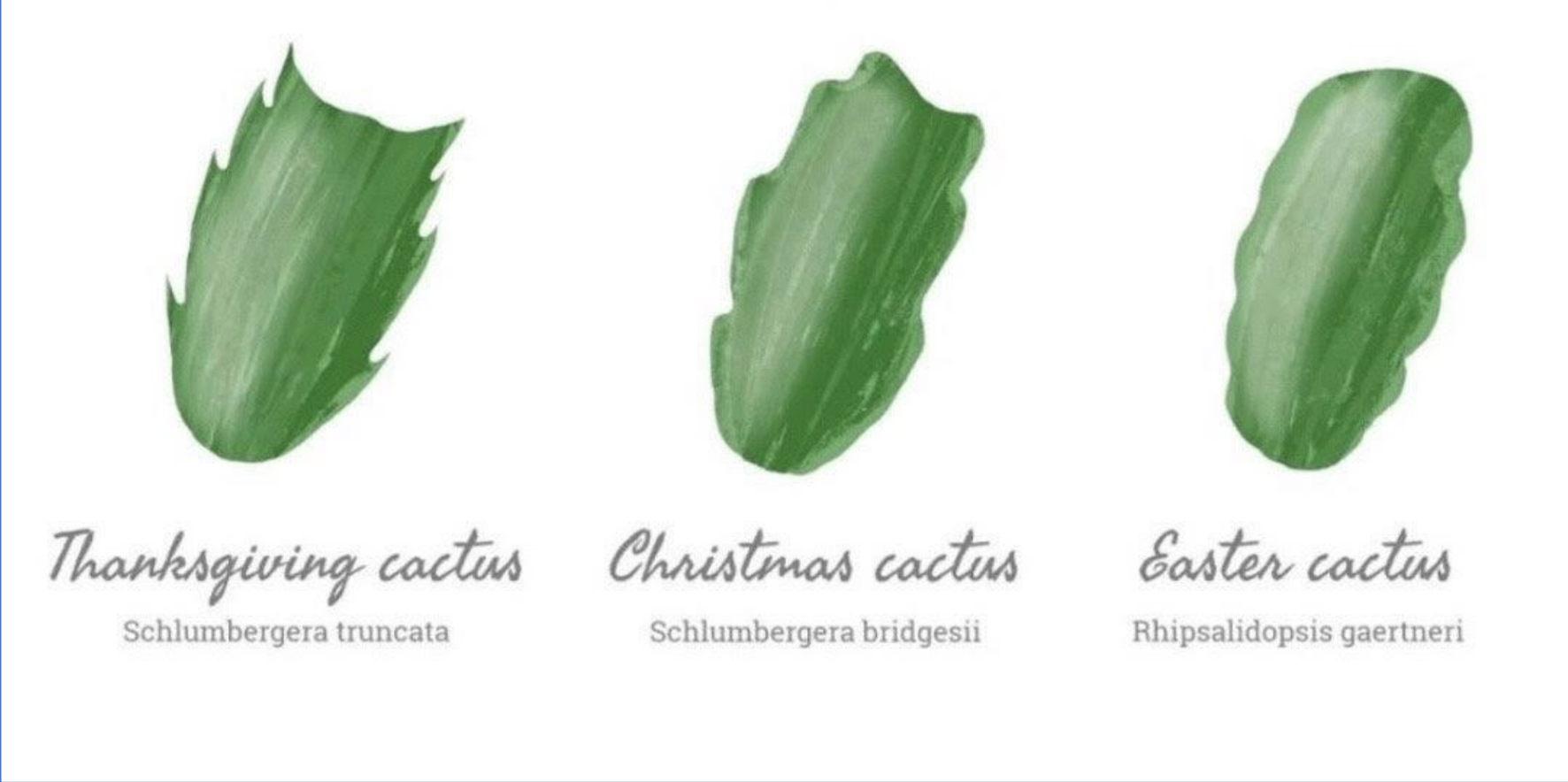
A better indicator of species is the shape of the leaf/ stem segment. Thanksgiving cacti have very pointed, claw-shaped projections on the edges of the leaf.
Christmas cacti have less spikey leaves and more rounded projections, while Easter cacti have subtle rounded edges along the leaf.
Also look at the flowers. They may appear almost identical (elongated and tubular) on both the Thanksgiving and Christmas cactus, but the former’s pollen is yellow while the latter’s is pink. Flowers of the Easter cactus are more star-like.
I thought I had two Thanksgiving cacti and that the slight difference in bloom time was the result of their different locations. Not so. One is obviously a Christmas cactus. You can see in the photos the noticeable differences in the leaves. What you can’t see is each plant’s pollen colour, but they, too, are different.
Schlumbergera are manageable, low-maintenance indoor plants. They thrive in well-draining, slightly acidic soil and bright, indirect light. You simply need to water them regularly and, ideally, feed them monthly from spring to fall with a balanced liquid fertilizer. They are easy to prune, easy to propagate, and easy to care for.
Available in an array of vibrant colours, they flower for weeks on end and can live for decades. In short, they make a wonderful addition to the holiday season and beyond.
The graphic that follows shows the different leaf shapes of holiday cacti. Does it help you identify which one(s) you have have in your house?